How Altafjord orcas and humpbacks hunt the herring
Every whale you might meet near Alta in winter has come for the same small silver fish. Once you know how orcas and humpbacks work a school of herring, the splashing fins on a grey fjord start to make sense. This guide explains the animals and the hunt, then how close the boats go.
The largest dolphin in the fjord
An orca belongs to the dolphin family and is its biggest member, even though most of us learned the name killer whale first. The black body with a white patch behind each eye shows up well, even in the dim blue light of an Arctic winter day.
Adult males grow a tall, straight dorsal fin that can reach about 1.8 m (6 ft). Females and younger animals carry a shorter fin with a backward curve. When a guide points out a male, look for that upright black blade first.
Orcas live in close family groups. Near Alta you usually see several fins of different heights surfacing together, and the group moves as one while it travels or hunts.
Why the herring draws them into the fjord
The Norwegian spring-spawning herring spends the dark months packed into huge schools in sheltered northern fjords. Lately large schools have wintered in the Altafjord and the fjords around it, and the whales followed them in.
The fish keeps no fixed address. Earlier winters saw most of the whales farther west near Skjervøy and Kvænangen, and the herring may move again. For the geography, see why the whales come into the Altafjord. The month-by-month guide follows the same fish through the season.
Carousel feeding, the orca method
In Norway, orca pods tend to hunt herring as a team. The pod circles a school and herds it into a tight ball near the surface and keeps the fish packed together by swimming around and under it.
Then an orca slaps the edge of the ball with its tail, knocking out a number of fish, and the pod eats them one by one. Scientists call this carousel feeding, and from a boat it looks like fins turning in a ring with bursts of white water between them.
Much of the hunt happens out of sight below the surface. On plenty of trips the orcas are traveling or resting between meals, and none of the tours can promise you a whale at all, let alone a feeding scene.
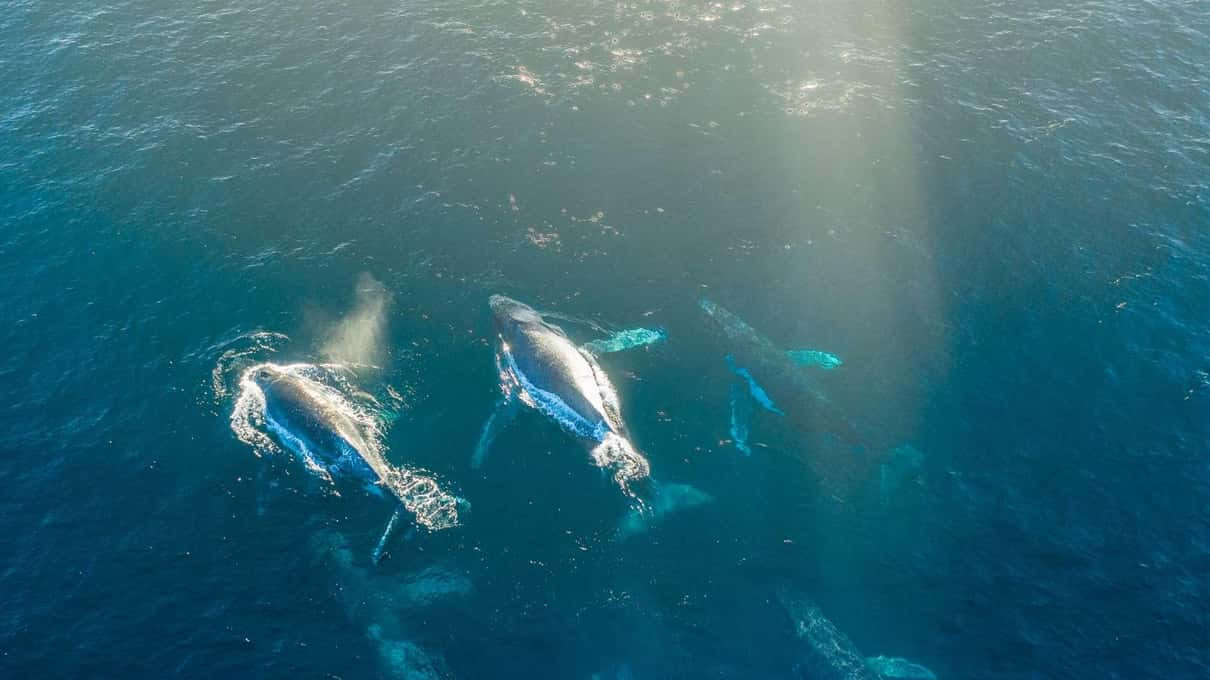
Humpbacks at the same schools
Humpback whales feed on the same herring with a very different technique. A humpback rises through a school with its huge mouth open, swallows a vast gulp of water and fish, then pushes the water out through the baleen plates in its upper jaw.
Gulls and other seabirds gather wherever the herring is driven toward the surface. A noisy cloud of birds over one patch of water is often the first clue a skipper steers for, and it can mean orcas or humpbacks are working below, sometimes both.
Now and then a fin whale joins the feast. It is long and fast and shows a tall blow above a slim grey back. Reviewers also mention dolphins and seals in the water, as well as harbour porpoises and white-tailed eagles along the shore.
Close to the water, engines off near the whales
Æventyr's open RIB carries no more than 12 guests, from ~$284 with a thermal suit and the rest of the cold-weather kit included. You spend about an hour on the water because of the cold, and the listing says the engines go off near the whales. It scores 4.9 from 31+ reviews on GetYourGuide. Age 12 and up.
What you see and hear from the boat
Most sightings start with a blow, a puff of mist hanging over the water for a second or two. A humpback's blow is tall and bushy, while an orca's is lower and harder to spot unless the air is still and cold.
After the blow come the backs and fins. Humpbacks often arch their back before a deep dive and lift the tail fluke clear of the sea, which is the classic photo. Orcas surface in quicker, smaller rolls, sometimes several at once.
With luck you may see a tail slap or a spyhop, when an orca lifts its head straight up to look around. On a calm day with the engine off you can hear the blows across the water, a deep whoosh that carries a surprising distance.
How close the boats go
Operators around Alta keep a respectful distance and let the whales decide how close they come. Æventyr's RIB listing says the engines are switched off near the whales, and a finnmark moods reviewer praised the crew for keeping a sensible distance.
We would never promise you a close encounter. Some days the whales surface a long way off, other days a curious humpback passes near the boat, and nobody on board controls which it will be.
These are watching trips only. None of the tours on this site offers swimming with the whales, and you stay on board the whole time.
Picking a boat for watching behavior
Eye level matters if you care about the hunt. On the low RIB from ~$284 you sit close to the water and see the splashes at their own height, but you trade that for about an hour on the sea and a lot of cold spray.
The heated boat on finnmark moods' fjord trip from ~$268 gives you more hours out there, with a warm cabin to retreat to between sightings. Longer on the water means more chances to catch a feeding scene when it happens.
Our boat type comparison sets out the trade-offs, and our page on trips without whales covers what happens if the fjord stays quiet. If you want to spend the evening under the sky as well, see pairing whales with northern lights.